
 When we, architects, speak of Discipline and Punish by Michel Foucault, we usually focus on Bentham's panopticon because it is definitely the most architectonic concept of this book. However we could also think about those pages, mostly about Jean Baptiste de la Salle's system of christian education which contemplate time and space in the same way that Charles Eames did with his powers of ten (see previous post); those time and space are not only controlable in the scale we experience but the real control can be reachable by exploring this infinite dimension of the "smallness".Nowadays, this disciplinary society could seem not to exist anymore, in favor of Virilio's society of control. Nevertheless, principles remain and their application become even more subtle as long as materiality is often not visible anymore.
Showing posts with label History. Show all posts
Showing posts with label History. Show all posts
# Discipline and Punish by Michel Foucault
When we, architects, speak of Discipline and Punish by Michel Foucault, we usually focus on Bentham's panopticon because it is definitely the most architectonic concept of this book. However we could also think about those pages, mostly about Jean Baptiste de la Salle's system of christian education which contemplate time and space in the same way that Charles Eames did with his powers of ten (see previous post); those time and space are not only controlable in the scale we experience but the real control can be reachable by exploring this infinite dimension of the "smallness".Nowadays, this disciplinary society could seem not to exist anymore, in favor of Virilio's society of control. Nevertheless, principles remain and their application become even more subtle as long as materiality is often not visible anymore.
# James Graham Ballard's article in The Guardian
 As in the cases of the pyramids and the Taj Mahal, the Siegfried line and the Atlantic wall, death always calls on the very best architects.
# Venus grotto
 Venus grotto is a totally artificial cave built for Ludwig II of Bavaria during second part of the XIXth century for his castle of Linderhof. The King wanted to reproduce the effect observed in Capri's blue grotto so he made a device of dynamos being set up to illuminate the grotto with several colors. It could probably be considered as one of the most expressive example of architectural lyrism.
# FIGHT WITH TOOLS /// 1871 Paris' Commune

This article has a strong connexion with last one about the canyon street. As a matter of fact, Paris' Commune was one of the most important urban conflicts in European history. It stayed nowadays as a good example of people's revolution as it last for a too short time to create a disenchantment. People who theorised about this event are many (Marx, Lenin, Debord...)During seventy two days of 1871’s spring, Paris city lived in secession from the National Assembly which just capitulated in war against the Prussians. Simultaneously the Commune defends itself against the national “versaillaise” army lead by Thiers and “play the game” of considering to exist for a long period. Thus is created a Central Comity whose representatives are originally from the working population.
As far as urbanism is concerned, Situationnists Guy Debord, Raoul Vaneigem and Attila Kotanyi, one century after the Commune was declared, considered that "it has been in Human History, the only production of a revolutionary urbanism" which assumes as a principle that no building is innocent. That is how the Vendome column was solemnly destroyed on may 16th. In fact this column was the symbol of the first Empire’s (Napoleon Bonaparte) authority and the Bourgeois’ power.
This urbanism can be thus said to substract the alienation zones within the city, which was called by Situationnist, positive holes. The Commune’s story illustrate quite clearly the dilemma which can appear with this operation. In fact, on may 24th, huge debates took place within the Central Comity to decide whether or not symbolic building should be destroyed before the national army win the conflict. That is how the City Hall, the Courthouse and the Tuilleries palace (which was never rebuilt since then) were burnt down but Notre Dame and the Louvre on the other hand stayed intact, because defended by artists collectives. Situationnist retrospectively judged that Paris’ cathedral has been saved because of “permanent aesthetic values belonging to museums’ spirit when other men legitimately wanted to access to expression this day by this destruction as a defiance to a society which was rejecting all their lives to silent.”
For more information about this chapter of France's history click here.
# Pruned / Ski in Chicago
 Here is an amazing article published by Pruned about 1954's Chicago stadium's ski jumping ramp installation...
# SELF-CONSTRUCTION /// Kowloon Walled City
 Kowloon Walled City can obviously not be literally considered as self-constructed. However, this Hong Kong district acquired a kind of autonomy for years and could not stop densifying itself until it was demolished by Authorities in 1993 (See Ryuji Miyamoto's photographs of the empty Walled City, ready to be tear down).The Walled City tackles an interesting problem about the connection such autonomous district could have with legality. In fact, there has been a strong phantasm of insecurity about it, probably encouraged by the authority when some neutral reporters like Greg Girard and Ian Lambot (read their "City of Darkness" from where almost all photographs we still have come from) affirmed that the district was the shelter of drug addict but not criminals.Before it was demolished, the Walled City was the home of 50 000 inhabitants reaching an incredible density of 1 920 000 inhabitants per square kilometre.As far as self-construction is concerned, let's quote City of Darkness:"With lifts in just two of the City's 350 or so buildings, access to the upper floors of the 10 to 14 storey apartment blocks was nearly always by stairs, necessitating considerable climbs for thos who lived near the top. This was partly alleviated by an extraordinary system of interconnecting stairways and bridges at different levels within the City which took shape -somewhat organically- during the construction boom of the 1960's and early 1970's. It was possible for example, to travel across the City from north to south without once coming down to street level."Let's add to this description, the one of this grid placed over the district's temple (right in the center of the Walled City) on which inhabitants having their windows on the courtyards throw away their garbage, transforming the temple's environment into a shadowy underworld.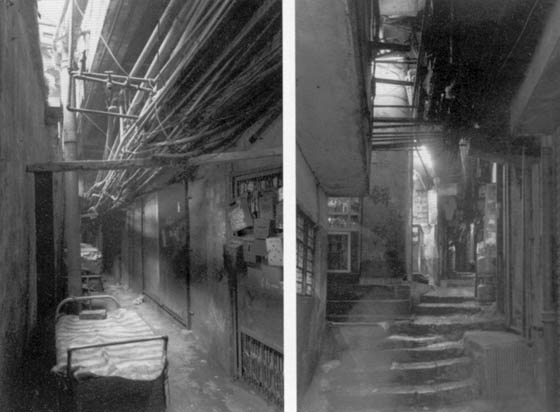


# Futurism in Paris, an explosive avant garde in Beaubourg
 Another very interesting current (until february 26th) exhibition in Pompidou Centre, is about how Italian futurism and French cubism influenced each other and eventually succeed to hybrid themselves during the beginning of the XXth century.Is futurist in his life:1. Whoever loves life, energy, joy, freedom, progress, novelty, functionality, speed.2. Whoever acts with instantaneous energy and does not hesitate by cowardice.3. Whoever, between two possible decisions, prefers the most generous one and the most daring one, towards improvement and individual and racial development.4. Whoever acts joyfully always turn towards tomorrow, without any remorse, without any pedantry, without any fake reserve, without any mysticism and without any melancholy.5. Whoever knows how to pass with agility from the most serious occupations to the most light distractions.6. Whoever loves life outdoor, sport, gymnastics, and heal each day the nimble force of his own body.7. Whoever knows, in useful times, to give a conclusive poke or slap(translation is mine so it may not be perfect...)Texts in Futurism are as important as painting or sculptures, therefore the bookshop ends the exhibition.Almost a century after, it is very important for us to observe the futurist's captivation for innovation and artefacts and how, by what Walter Benjamin did prophesy as an esthetisation of politic, this art movement took part in fascism ideology and great support for war:War ? Yes, war is our only hope, our reason for living, our only wish! Yes war ! War against you who die too slowly, and against all the dead bodies which block up our roads.
Filippo Tommaso Marinetti
Such intensity and integrity in art, is quite amazing to observe nowadays and I do recommend books which tried to gather all the futurist manifests (there are several !) like Jean-Pierre de Villiers' one which is unfortunately only in French...
# Seuthopolis: a city underwater
The thracian city of Seuthopolis (Bulgaria) have been discovered in the 1940's but have been flooded by a water preservation project just after this discovery.The architect Zheko Tilev make the proposal of the following project to bring tourism to this low developped region of Bulgaria. It's a huge dam around the antic city to bring it back to the air.(I just hope that it won't be like in Felini's Roma when the modern atmosphere is erasing all the antic paintings !)


Tilev Architects - Seuthopolis, Bulgaria (Copyright Tilev Architects)
# La Cité Frugès by Le Corbusier
 "Je vous autorise à réaliser dans la pratique de vos théories [...] Pessac doit être un laboratoire" ("I allow you to achieve your theories [...] Pessac must be a laboratory") Henri Frugès said to Le Corbusier in 1924 when he orders the achievement of a garden city for his workers in Pessac (Suburbs of Bordeaux).After theoric works like Citrohan House, Domino House, Plan Voisin, Le Corbusier is thus able to achieve his architecture at big scale.
 Le Corbusier and his cousin, Pierre Jeanneret organised the site with five different kinds of buildings:
 Isolated (70m²)
 Skyscraper (110m²)
 Zigzag (80m²)
 Archway (85m²)
 Staggered Rows (80m²)Pessac was famous for a long time as the Modernism's failure. In fact, housing were originally planned to be three times cheaper to build than what they actually were (only 50 housing were actually built instead of 135 expected).
Then, as years went by, buildings were transformed little by little by its inhabitants who obviously prefered traditionnal ways of housing than modernism ones. Nowadays, a lot of buildings were renovated but there are still some of them which still show inhabitants readjustments.Infact, Pessac still tackles the problem of the breakage between innovation and tradition and also the architect's knowledge and competence to think and act in favor of people who undergo architecture every day.


# Flooded London 2090, a tranquil Utopia
 Flooded London 2090 is an exhibition created by the graffic design office Squint/Opera in Medcaft Gallery (London) and dramatises the old Tyler Durden's (Fight Club) dream to sea a city as London re-colonized by nature. We are now in 2090 and London has been gain on the sea level several years ago, and urban life has been re-organised peacefuly as a tranquil Utopia. Some women are fishing in an abandonned Canary Wharf building, a man is diving from St Paul's dome...everything is simple and silent.
So who is still afraid from the future ?


Of course it remains me of something in the past; Paris beeing flooded in 1910 (see an older post) and Boulevard Haussmann becoming Venice's Grand Canal.

It also remains me of Michael Anderson's Logan's run (1976) when Logan 5 and Jessica 6 discover Washington back to nature and Capitole's dome invaded by ivy !


# Valse avec Bachir de Ari Folman
 Un très bon film en ce moment en salles, Valse avec Bachir de l'israélien Ari Folman. Ce film porte à la fois sur les mécanismes mis en place par la mémoire humaine pour se protéger des horreurs de la guerre et sur un épisode historique tragique pour le Liban en 1982, le massacre des camps de réfugiés palestiniens de Sabra et Chatila à Beyrouth par les "phalangistes" sympathisants du Bachir Gemayel tout juste assassiné. Cet épisode de l'Histoire pèse sur certaines consciences israéliennes, l'armée étant présente et n'étant pas intervenue.
Le graphisme du film est assez beau et remarquablement cohérent avec ces mêmes mécanismes de subjectivation de la mémoire.
Un film très fin donc, à voir...


# Am ende kommen Touristen (Et puis les Touristes) de Robert Thaleim
 Très bon film allemand (titre en France: Et puis les touristes) narrant le service civil d'un jeune allemand à Auschwitz qui n'est ici qu'un exemple comme d'autres de lieux tendant vers le passé aussi bien pour des raisons économiques que mémorielles. Les habitants de ces lieux se retrouvent ainsi prisonniers/gardiens du souvenir "touristique".
Le tout est traité de manière très fine et subtile et peut faire penser à beaucoup d'autres territoires happés par le passé.


cinémas parisiens: Reflet Médicis (Ve), Sept Parnassiens (XIVe), UGC Ciné-Cité les Halles (Ier) et Lincoln (VIIIe)
# L'aérotrain ou le futur du passé...
 Si vous connaissez quelque peu le Loiret, vous avez peut être aperçu cet ouvrage quelque peu surprenant traverser les champs en ligne droite.
Il s'agit en fait des ruines d'un projet des années 60-70 qui incarnait pourtant à l'époque le summum du futurisme de type "en l'an 2000...." Ce projet est celui de l'aérotrain. Dès 1964, soit trois ans seulement après le dépôt de brevet du coussin d'air, le projet se met en route. En 1969, est construit 18 km de voies près de Orléans et le prototype atteint la vitesse de 420 km/h (pour info bien que le tgv ait récemment atteint la vitesse record de 570km/h, la vitesse normale ne dépasse jamais 320km/h).
Ce projet aurait pu être généralisé mais il est abandonné en 1977 pour diverses raisons allant du lobbying ferroviaire en faveur de ce qui deviendra le TGV, aux conséquences du premier choc pétrolier.
Un certain nombre de linéaire de la ligne d'Orléans fut détruite à l'aide d'une pince assez impressionnante (voir photos et vidéo) mais il subsiste néanmoins plusieurs fractions.
Dernièrement Raphaël Zarca (professeur à l'ESA) et Vincent Lamouroux ont conçu le "pentacycle" qui permet un déplacement dont la lenteur relative chamboule le souvenir de la très grande vitesse du train historique.
Aujourd'hui EDF projette d'y installer des panneaux solaires.
NB: L'aérotrain qui fonctionne sur coussin d'air n'est pas à confondre avec le train à sustentation magnétique allemand, que l'on peut observer à Shanghai sur des rails quelques peu similaires. Ce dernier fonctionne en effet grâce à une répulsion continue provoquée par la même polarité des pôles train et rail


Subscribe to:
Posts (Atom)