
 No matter if we consider past or contemporary self-constructions, those architecture without architects embody a kind of expression of an individual or associative power in the trespassing or not of a local legislation. Their essential motivation often has a vital statute which answer thus more to needs than desires. These needs is then materialized into a shape and a space.No forward planning for self-constructed districts brings to the city a disinclination which can not be harmful for democracy. In fact, those buildings' construction and life are happening thanks to a local negotiation between people directly concerned by them. Architecture is thus the product of this neighbourhood negotiation. Result is an organic network of buildings as a urban fabric uncontrollable by any human authority.
Showing posts with label thematic SELF-CONSTRUCTION. Show all posts
Showing posts with label thematic SELF-CONSTRUCTION. Show all posts
# SELF-CONSTRUCTION /// Conclusion
No matter if we consider past or contemporary self-constructions, those architecture without architects embody a kind of expression of an individual or associative power in the trespassing or not of a local legislation. Their essential motivation often has a vital statute which answer thus more to needs than desires. These needs is then materialized into a shape and a space.No forward planning for self-constructed districts brings to the city a disinclination which can not be harmful for democracy. In fact, those buildings' construction and life are happening thanks to a local negotiation between people directly concerned by them. Architecture is thus the product of this neighbourhood negotiation. Result is an organic network of buildings as a urban fabric uncontrollable by any human authority.
# SELF-CONSTRUCTION /// Kowloon Walled City
 Kowloon Walled City can obviously not be literally considered as self-constructed. However, this Hong Kong district acquired a kind of autonomy for years and could not stop densifying itself until it was demolished by Authorities in 1993 (See Ryuji Miyamoto's photographs of the empty Walled City, ready to be tear down).The Walled City tackles an interesting problem about the connection such autonomous district could have with legality. In fact, there has been a strong phantasm of insecurity about it, probably encouraged by the authority when some neutral reporters like Greg Girard and Ian Lambot (read their "City of Darkness" from where almost all photographs we still have come from) affirmed that the district was the shelter of drug addict but not criminals.Before it was demolished, the Walled City was the home of 50 000 inhabitants reaching an incredible density of 1 920 000 inhabitants per square kilometre.As far as self-construction is concerned, let's quote City of Darkness:"With lifts in just two of the City's 350 or so buildings, access to the upper floors of the 10 to 14 storey apartment blocks was nearly always by stairs, necessitating considerable climbs for thos who lived near the top. This was partly alleviated by an extraordinary system of interconnecting stairways and bridges at different levels within the City which took shape -somewhat organically- during the construction boom of the 1960's and early 1970's. It was possible for example, to travel across the City from north to south without once coming down to street level."Let's add to this description, the one of this grid placed over the district's temple (right in the center of the Walled City) on which inhabitants having their windows on the courtyards throw away their garbage, transforming the temple's environment into a shadowy underworld.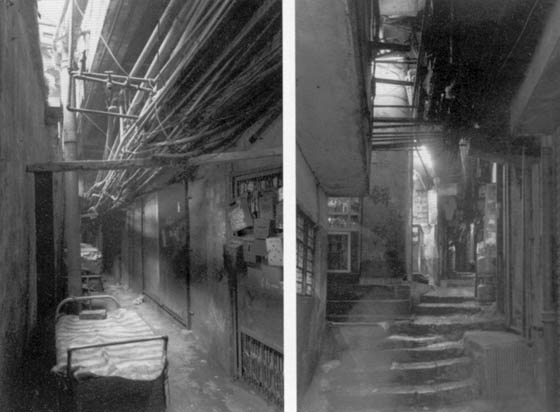


# SELF-CONSTRUCTION /// The gridshell
 YO! here is a pretty cool construction system that have been develloped by Frei OTTO and then applied in several building like the Japanese Pavilionby Shigeru Ban with Frei Otto at Expo Hanover 2000, the Polydome of the EPFL (école polytechnique de Lausanne) or the Dowland gridshell by Edward Cullinan Architects + Structural Engineer Buro Happold.
 Few words to explain how to build one in your backyard:1- Do a planar wooden grid that can rotate on crossings...2- Pull slowly the point(s) that
 you want to see up until you get the shape you wanted...3- Block the points that you want to keep on the ground with weights or punctions...4- Cover the grid with thin plank that you nailled into the grid, do this two or three layers...5-You got your own gridshell building!following some pictures:Japanese Pavilion, Expo 2000


 Polydome de l'EPFL (CH)

 Downland Gridshell (UK)


# SELF-CONSTRUCTION /// Ice as a building material

The pretty cold weather in Paris made me think about igloo building! (sadly it's not possible there...)Building an igloo is a very interesting concept of using one material, the ice, and building a close space without any transformation of the material, any nails or glue, just ice!This free material had already inspired some architects that desiged some cool pavillion for the Snow Show. I supposed that they were not part of the building team (if that ever happened) !
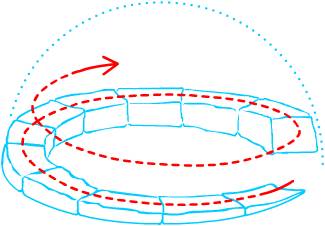


 Tadao Ando @ the snow show
 Zaha Hadid @the Snow show
# SELF-CONSTRUCTION /// Tungkwan
 Another example of self-construction in Bernard Rudofsky's Architecture without Architects.
One of the most radical solutions in the field of shelter is represented by the underground towns and villages in the Chinese loess belt. Loess is silt, transported and deposited by the wind. Because of its great softness and high porosity (45 per cent), it can be easily carved. In places, roads have been cut as much as 40 feet deep into the original level by the action of wheels. The photographs show settlements of the most rigorous, not to say abstract, design near Tungkwan (Honnan). The dark squares in the flat landscape are pits an eighth of an acre in an area, or about the size of a tennis court. Their vertical sides are 25 to 30 feet high. L-shaped staircases lead to the apartmments below whose rooms are about 30 feet deep and 15 feet wide, and measure about 15 feet to the top of the vaulted ceiling. They are lighted and aired by openings that give onto the courtyard. "One may see smoke curling up from the fields" writes George B. Cressey in his Land of the 500 million: A geography of China, even though there is no house in sight; "such land does double duty, with dwellings below and fields upstairs." The dwellings are clean and free of vermin, warm in winter and cool in summer. Not only habitations but factories, schools, hotels and goverment offices are built entirely underground.


# SELF-CONSTRUCTION /// I.A.A.C. 2nd Advanced Architecture Contest
Last Issue of the I.A.A.C. Institue of (Advanced Architecture of Catalunya) architecture 2007-2008 competition was about "self fab sustainable housing", following you'll will see the 3 prizes that have been decerned to international students/architects.
 2nd prize:

 you can see better picture of the second prize wich is for me the most interesting : here3rd prize:


Awarded projects:
1st Prize: F1C243 Ming Tang Dihua Yang CHINAThis proposal uses a traditional local material, implementing geometry elements in a pertinent way creating structures able to transform and re-inform themselves . The jury values its landscape integration and the possibility of being constructed as prototype.
2nd Prize: 5923BC Luis Aguirre Manso SPAINThe jury values the hybridisation of light construction systems that rise from the ground, and the functional scheme surrounding the chimney, that follows principles of traditional architecture.
3rd Prize: C2BD4E Shinya OKUDA Kung Yick Ho Alvin Lam Yan Yu Ian HONG KONGThe jury values the use of advanced technologies in the manipulation of biodegradable materials to create a system that can be assembled as a sustainable construction.
1st prize:
 2nd prize:

 you can see better picture of the second prize wich is for me the most interesting : here3rd prize:


# SELF-CONSTRUCTION /// Robert Neuwirth's shadow cities
 One of self-construction's motivation comes from the fact that it is difficult for the authority to control and thus, sometimes its illegal existence for a more or less important time. That is one of the topics tackled by Robert Neuwirth in his book, Shadow cities. A billion squatters, a new urban world. In fact, for his research, this author lived for a while in one of Rio's favelas and other illegal district in Nairobi (Kenya), Mumbai (India) and Istanbul (Turkey). For each city, he is interested in observing how these districts' inhabitants manage to negociate with their environment's illegal existence thanks to a bypass or an interpretation of the law, which allow their juridical eviction to be more difficult. That is how we learn that, a Turkish law affirms that an illegal building in construction can be destroyed immediately whereas, an achieved building could only be demolished after judiciary proceedings. Therefore a lot of buildings are built very quickly during the night, to limitate as possible the vulnerability period. It is then interesting to observe how the bypass of law influence architecture and become a collective tacit knowledge which rules the district organisation.
# SELF-CONSTRUCTION /// Straw as a building material
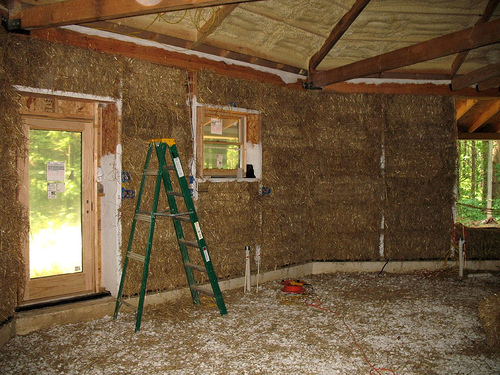
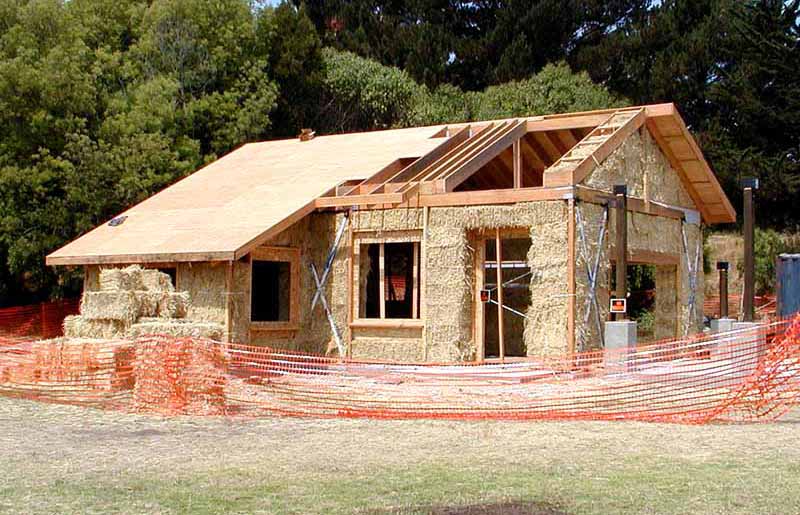
 Following you will find few pictures of self constructed houses builded with straw, most of time those buildings got a very poor architecturale quality...But I think this building technics wich is, about sustainibility, thermic and cost specially , one of the most interesting, and it's just at the beguinning of its reality as a real construction material, I hope that in the coming months/years we will see more experimetation with that material.More over its really easy to find individuals sites following this kind of self construction initiatives.By now the major probleme of that technic (straw bale+clay) is that needs a lot of handwork to apply the clay on the straw walls, so if your interested in building one in yourbackyard, you had better to have lot of enthousiastic friends or a big familly!If you saw a cool straw building let us now we are interesting to publish it on Boiteàoutils !

 this one have been designed by HOK ,(found on inhabitat.com more here)


Subscribe to:
Posts (Atom)